
PRESS RELEASE
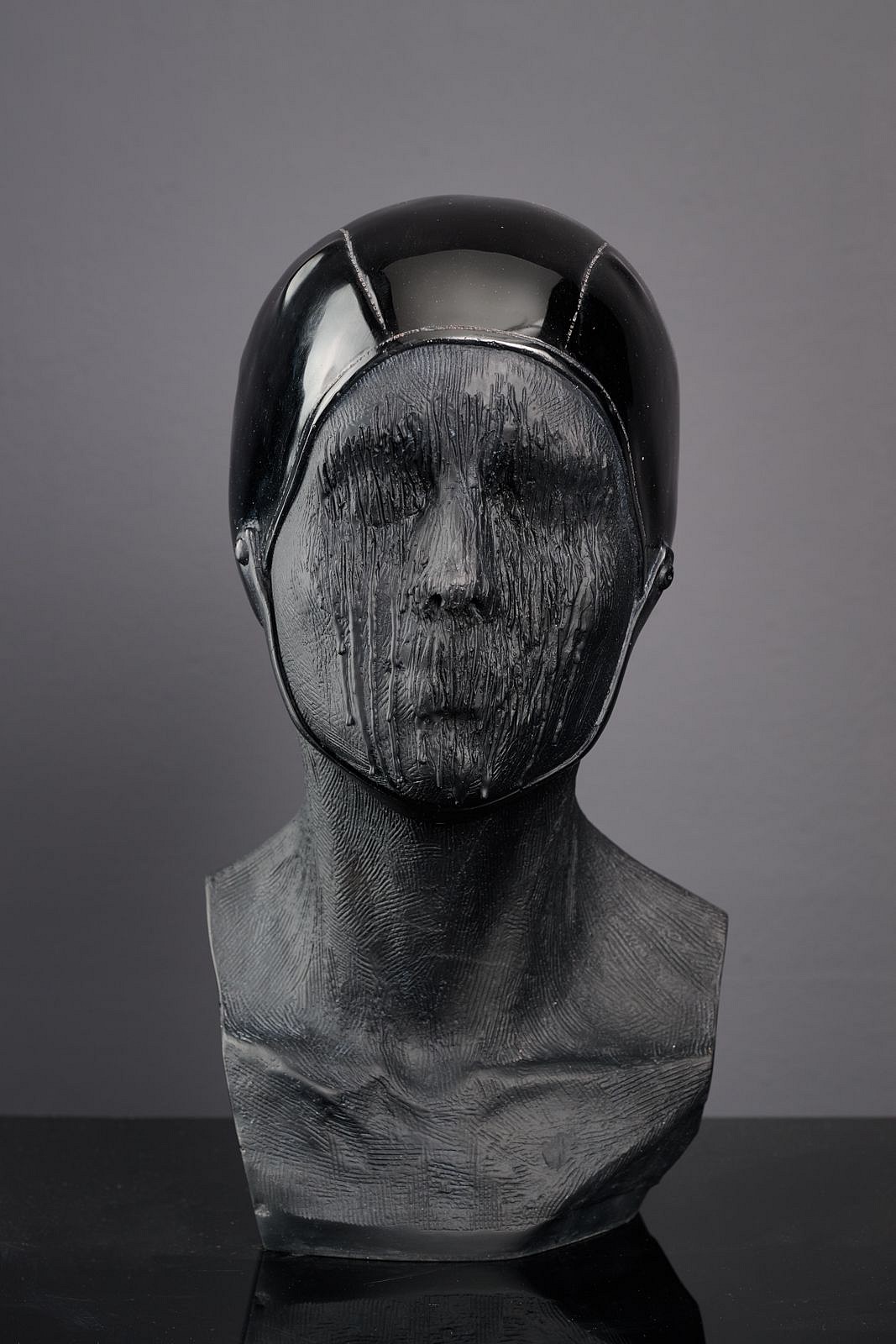
The Persistence of Nothingness
Jan 15 – Mar 5, 2026
Noa Ben-Nun Melamed • Katya Izabel Filmus
Curator: Hadas Glazer
In The Persistence of Nothingness, the artists Noa Ben-Nun Melamed and Katya Izabel Filmus create a dark world in shades of gray and black, with rare bursts of color and light. This is a world that takes shape out of nothingness: What exists in it is defined by what is absent from it, what faded away, and what only lingers as a trace. The works that comprise it recount a loss of stability and expose a traumatic and insurmountable gap between the familiar and the uncanny, and between safety and failure.
At the heart of the encounter between the two lies the dimension of time. In Filmus’s sculptures, the immortalization of the melting material sets dissolution itself as the subject of the work. The suspension of the material transformation places us between the familiar, stable, and known and the foreign and menacing. The domestic objects are infused with the stillness, rigidity, and imperviousness of the flowing-melting glass, as if in a capsule where time has become warped, disconnected from the linear sequence, and removed from context.
In Ben-Nun Melamed’s practice, the question of time takes a different direction: Her works seem to unfold primordial or post-apocalyptic realms, populated by landscapes and objects that survived as relics of imagined cultures or as geological memories. She applies acts of fragmentation, replication, inversion, and resizing to the photographic image, until it becomes photographed-but-fabricated evidence that strives to be seen, preserved, and curated.
The link created in the exhibition between glass and photography is not just a connection between mediums; it underscores both artists’ use of light and its physical properties. Filmus’s works are mostly black and opaque – in a departure from the translucence associated with glass. They stop light from traveling through them, freezing a moment in time as well as the disintegration of the material as a mental testimony. Conversely, Ben-Nun Melamed’s altered photographs are created through exposure to light: In her work, she deconstructs documented landscapes and objects and recreates them as imagined spaces, where the light not only illuminates but also creates and erases. This affinity conjures a space where the post-war present is experienced as a portal that offers access into nothingness: to what was once there and is now gone. To the persistent presence of absence.
The exhibition’s name, The Persistence of Nothingness, is a paraphrase on the title of Salvador Dalí’s painting The Persistence of Memory (1931). In this famous work, Dalí sought to highlight the relative and flexible nature of time, often perceived as fixed and permanent. Within the dreamlike logic of the painting, memory takes on an elastic, fluid, and transformative quality. This equivalence accentuates the similar quality of nothingness in the exhibition: The absence it captures in its elusiveness becomes present, tangible, sensed, and corporeal, with volume and mass. In this context, the essence of nothingness is to leave traces and endure as a memory.
In a post-war reality, The Persistence of Nothingness echoes trauma not through direct representation, but through what is missing and what has been omitted: traces of home, time, and body, color and light, and the unbridgeable distance between what used to be and what will never be the same.
Noa Ben-Nun Melamed
In her work, Ben-Nun Melamed formulates a poetic language through which she explores and interferes in the photographic image. Sometimes, she tests the feasibility of turning it into an object, using various sources, instilling it with movement, and examining different forms of display. She sees the moment of taking a photograph not as the endpoint but as the beginning; a moment that holds reflection and construction of inner contents – an act of transformation from the concrete to the symbolic.
The works in the exhibition are from three different series, in which the artist looks through the narrow crevice of her existence into the abyss that precedes life and into the abyss at its end, creating worlds and objects that exist before creation or at the end of time.
The series Archaeography started from photos of archaeological artifacts and rock formations shaped by time and water, all taken in Israel. From these, Ben-Nun Melamed created new objects that bring to mind ceremonial, shamanic, or cosmic artifacts, an iconography of an imagined local culture. In Time Zones, she continues to compile a fictional archaeological museum, photographing objects from her parents’ home, mostly ones that were salvaged from the depths of the sea, and then digitally altering them. In the empty spaces that open inside them she inlays landscapes, which become a part of the object’s legacy and memory. The artifacts are cut and extracted from the background that surrounds them and presented as three-dimensional objects in display cases. Next to them, two landscape photographs are interwoven with relics of civilizations that will soon be submerged under the rising seas. In the series Bardo Land, Ben-Nun Melamed explores the liminal space between death and rebirth. The Buddhist concept of “Bardo” refers to the transitional states in-between life and death. For the artist, it represents the movement between the life drive and the longing to disappear. The works consist of photographs from Iceland and Tenerife, from which the artist composed fictional geological spaces, expressing the idea that nothingness does not mean no-thing, but rather contains what once was and what is yet to come.
•
Noa Ben-Nun Melamed was born in 1954 in Haifa and grew up on Kibbutz Maagan Michael. She currently lives in Tel Aviv and is a mother of two sons. She received the prestigious Enrique Kavlin Lifetime Achievement Award for Photography, the Israel Museum Prizes for Art and Design (2019–2020). Graduated from the Photography Department at Hadassah College of Technology, holds a B.Ed. from HaMidrasha School of Art, Beit Berl College, and an MFA from Lesley University. Her works have been featured in numerous solo and group exhibitions in Israel and worldwide, and are included in several prominent private and public collections, among them the Israel Museum, the Israeli Knesset, Eretz Israel Museum, and Ein Harod Museum of Art. She also created two artist books, “Half a Mega of Memories” and “Atlantis.” Alongside her artistic practice, Ben-Nun Melamed has taught photography at Hadassah Academic College in Jerusalem and at other academic institutions, educating generations of photographers, and curated numerous exhibitions.
Katya Izabel Filmus
In her glass works, Katya Izabel Filmus sets out to capture disintegration and material transformation into a sculptural object. Using complex casting processes, she explores memory, identity, and the human body as a site where fractures, cracks, and layers of time are inscribed, creating precise sculptural images, impregnated with memory and experience. The sculptures in the exhibition are taken from the series Temporal Disintegration – a term that defines a dissociative experience manifested as a breakdown of regular time perception, linked to emotional trauma. The demanding casting process in the lost wax method includes several stages of dripping and pouring wax around found objects, melting it, and casting glass in its place. This layered process captures and immortalizes the duration of disintegration in material form, making it the central theme of the sculptures.
The melted, dripping wax collapses from the walls of the objects, sometimes outward and sometimes inward, creating a mold into which Filmus pours black, dense and opaque glass, which seems to defy the properties most associated with this material. The artistic process preserves every tiny hint of material distortion; where there was material, there is nothing, and where there was no material, there is an uncontrolled material expansion. Only one scene, consisting of a building brick, a bowl, and putty knife, remains intact, encapsulated in frosted glass that restores the glass its transparency. The tension between the artistic-formal values ??of black and white, opaque and translucent, and solid and liquid, underscores the emotional tension between trauma and hope.
The melting and half-collapsing works stand as a silent testament to the ways trauma leaves its mark on banal everyday objects. Building blocks, a clock, a framed picture, a pair of slippers: elements from the domestic space, which have taken a dark turn that hints at the devastating consequences of war. Created in the aftermath of Oct 7, the series centers on the domestic structural collapse and the mental experience of dissociation, which can be manifested as a disruption of the sense of time. The familiar household objects become uncanny, embodying the scars that past and present traumatic events etch into human existence.
•
Katya Izabel Filmus holds a BFA from Bezalel Academy of Arts and Design in Jerusalem and an MA from the University of Sunderland, UK. Her works have been featured in numerous exhibitions in Europe, the US, and Israel, as well as in the public space. They are kept in public and private collections such as the Eretz Israel Collection in Tel Aviv, Museum del Vetro in Murano, Italy, and the Stanley Picker Trust in London. Filmus is part of a new group of glass artists who push the boundaries of the medium in the contemporary art world, combining advanced technical skills with sophisticated conceptual thinking. In 2026, she will deliver a guest lecture at the Corning Museum of Glass Casting Symposium.
Installation Photography: Youval Hai.
Reproduction Photography: Youval Hai (Katya Izabel Filmus)
Exhibition Catalogue:


